
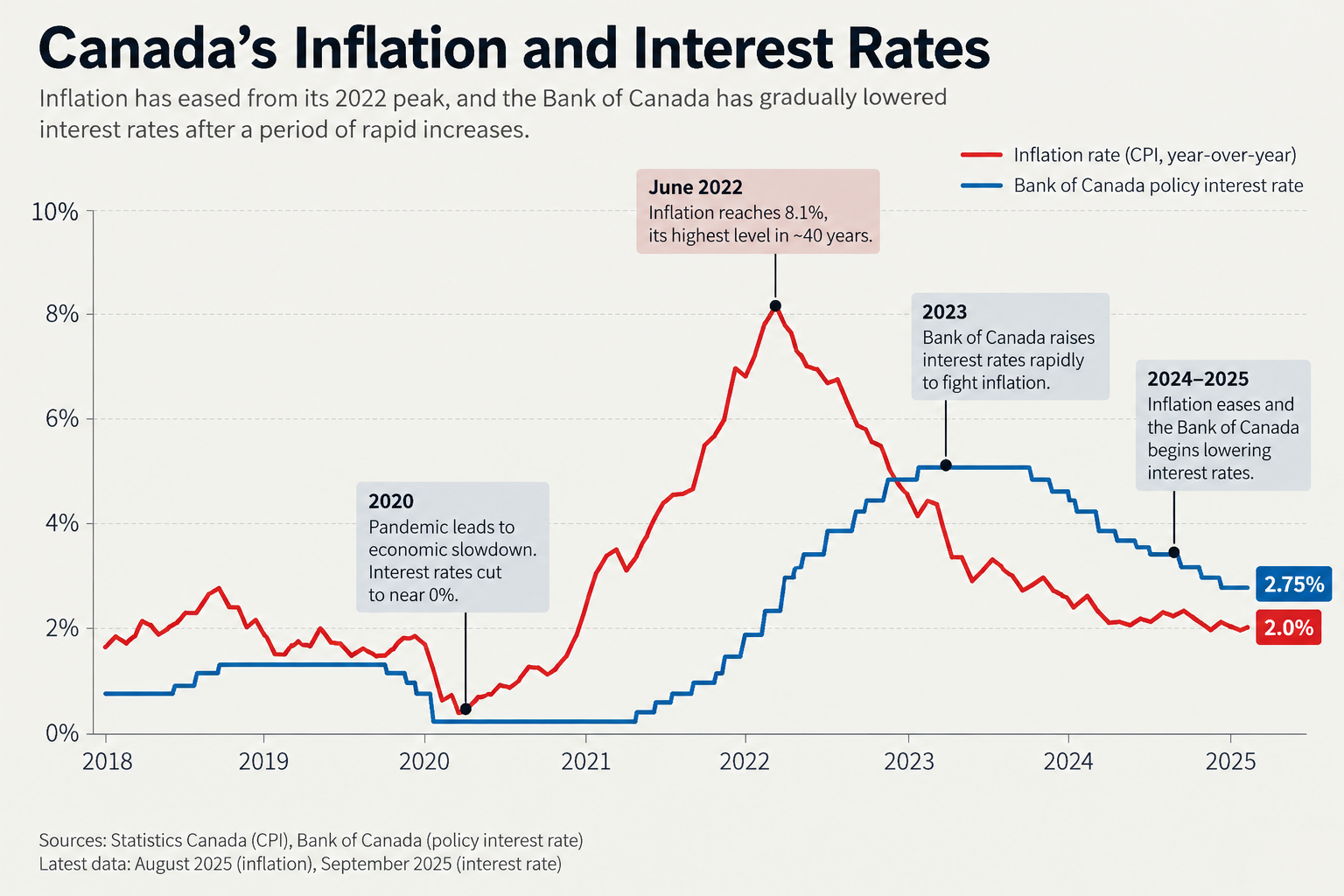
With inflation running above target and the next rate decision approaching, here’s what could influence the Bank of Canada, and what it means for mortgages, savings, and household budgets.
Canada’s next interest-rate decision is scheduled for October 28, 2026.
The Bank of Canada held its target for the overnight rate at 2.25% on September 2. The Bank said inflation risks had increased, even as trade uncertainty complicated the outlook for economic growth. Its next announcement will also include a new Monetary Policy Report. [1] [2]
A rate cut is possible, but it is not guaranteed. Understanding the decision means looking at inflation, economic activity, and the trade-offs facing the central bank.
THE QUESTION TO WATCH
Can the Bank support a fragile economy without allowing inflation to stay too high?
01 / WHERE RATES STAND
Canada’s Policy Rate Is 2.25%
The overnight rate is the Bank of Canada’s main monetary-policy tool. It influences the cost of short-term borrowing between financial institutions and helps shape the interest rates Canadians encounter on loans, lines of credit, and deposits.
BANK OF CANADA POLICY RATE
2.25%
As of October 21, 2026
October 28
Next scheduled decision · 9:45 a.m. Eastern
A quarter-percentage-point change would move the policy rate from 2.25% to 2.00% if cut, or to 2.50% if raised. Those are illustrative scenarios, not forecasts. [3]
02 / THE INFLATION PROBLEM
Inflation Is Still Above the Bank’s Target
Statistics Canada reported that the Consumer Price Index increased 3.1% year over year in September 2026, up slightly from 3.0% in August. Gasoline prices were a major contributor: they rose 27.8% from a year earlier. Excluding gasoline, inflation was 2.2%. [4]
SEPTEMBER 2026 INFLATION SNAPSHOT
| Headline CPI inflation | 3.1% |
| Inflation excluding gasoline | 2.2% |
| Food purchased from stores | 1.7% |
| Transportation | 8.4% |
Year-over-year changes. Source: Statistics Canada, released October 19, 2026. [4]
The Bank of Canada aims to keep inflation near 2%, the midpoint of its 1% to 3% control range. Inflation above that midpoint does not automatically rule out a cut, but it makes the outlook more complicated.
The distinction between gasoline-driven price increases and broader inflation matters. If energy costs remain elevated or spread into other prices, the Bank may have less room to lower rates. If price pressures ease while the economy weakens, a cut could become easier to justify.
03 / WHY THE DECISION IS DIFFICULT
A Slower Economy and Higher Prices Can Pull in Opposite Directions
Lower interest rates can encourage borrowing, spending, and business investment. That can be helpful when economic growth is weak. But easier financial conditions can also add demand and make inflation harder to control.
In September, the Bank described increased upside risks to inflation from high energy prices and trade-related costs, while also acknowledging uncertainty about Canada’s growth prospects. [1]
Three outcomes are possible
A rate cut: The Bank could lower its policy rate if it judges that weak demand and slower growth pose greater risks than persistent inflation.
A hold: It could leave the rate unchanged while waiting for clearer evidence about inflation and the economic recovery.
A rate increase: It could raise the rate if it sees inflation becoming more persistent or spreading across the economy. These are scenarios rather than predictions about October 28.
04 / YOUR MONEY
What a Rate Change Could Mean for Canadians
Variable-rate mortgages and lines of credit
Variable borrowing rates are often linked to lenders’ prime rates, which typically respond to changes in the Bank’s policy rate. A cut could lower interest charges for some borrowers. The effect on monthly payments depends on the mortgage contract: some payments change, while others stay fixed and change the portion going toward principal.
Fixed-rate mortgages
Fixed mortgage rates are influenced more directly by bond yields and market expectations than by a single overnight-rate announcement. A Bank of Canada cut does not guarantee an immediate reduction in fixed mortgage offers.
Savings accounts and GICs
If market rates decline, banks may reduce interest paid on savings accounts or newly issued guaranteed investment certificates (GICs). Existing fixed-rate GIC contracts generally keep their agreed rate until maturity.
Business borrowing
Changes in financing costs can affect expansion plans, equipment purchases, and cash flow. But business decisions also depend on customer demand, confidence, and credit availability—not just the central bank’s rate.
05 / AN EXAMPLE
What Would a 0.25-Point Cut Actually Save?
Consider a hypothetical $20,000 balance on a variable-rate line of credit. If its annual interest rate fell by 0.25 percentage points and the balance stayed constant, the simple annualized interest reduction would be:
$20,000 × 0.0025 = $50
Approximately $50 per year, or $4.17 per month
This is an illustration, not a personalized estimate. Actual savings depend on when a lender changes its rate, daily balances, compounding, fees, and the terms of the credit agreement.
06 / WHAT TO WATCH
The Signals That Matter Before October 28
Inflation details: Headline CPI rose 3.1% in September, but excluding gasoline it rose 2.2%. The Bank will consider whether price pressures are broadening or easing. [4]
Economic activity: Weak demand could favour easier policy, while stronger-than-expected activity could reduce the urgency to cut.
Energy and trade: Oil prices, tariffs, and supply disruptions can push costs higher even when domestic demand is soft. [1]
The Monetary Policy Report: On October 28, the Bank will release updated economic projections alongside its rate decision, offering insight into how policymakers see growth and inflation evolving. [5]
THE NUMERAL BREAKDOWN
Three Things to Remember.
01. The Bank of Canada’s policy rate is 2.25% ahead of its October 28 announcement. The next decision has not yet been made.
02. September inflation reached 3.1%, with gasoline contributing heavily. The Bank must weigh inflation risks against economic weakness.
03. Rate changes affect Canadians differently. Variable-rate debt, fixed mortgages, savings products, and business loans do not all respond in the same way.
RESEARCH AND REFERENCES
Sources
[1] Bank of Canada. “Bank of Canada maintains the policy rate at 2¼%,” September 2, 2026.
Read the official announcement
[2] Bank of Canada. “Bank of Canada publishes its 2027 schedule,” July 27, 2026 (reconfirming 2026 dates).
Read the announcement schedule
[3] Bank of Canada. “Policy interest rate.”
Learn how the policy rate works
[4] Statistics Canada. “Consumer Price Index, September 2026,” October 19, 2026.
Read the inflation report
[5] Bank of Canada. “Upcoming events,” October 28, 2026 interest-rate announcement and Monetary Policy Report.
View the upcoming announcement
North Numeral.
MONEY, MADE CLEARER.
Explore more financial articles →
Published October 21, 2026. This article is educational and informational only, not personalized financial, mortgage, or investment advice. Interest-rate decisions and economic data can change. Consult official sources and qualified professionals when making financial decisions.

Leave a Reply